

Commitment to Inclusion
Building on our heritage of more than 55 years and our unique relationship with Detroit as our home, the School of Architecture & Community Development is internationally recognized for our social, economic and environmental justice-driven and student-centered approach
The School is divided into two departments — Architecture and Community Development — and one applied teaching/research center, the Detroit Collaborative Design Center.
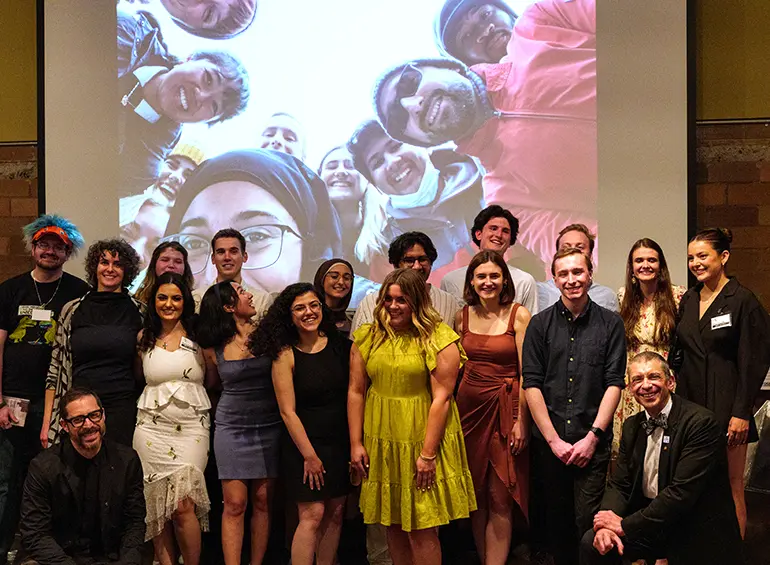
SACD is an intentional community of approximately 230 students (200 Architecture and 30 Community Development), served by 50 accomplished full-time (13) and part-time (37) faculty. Each student becomes an integral part of a diverse student body, working alongside faculty, administrators and staff to imagine and create change. We are close-knit community, and cherish our relatively small size. Because of this rapport, our students are never lost in the back row of theater-style classes. They are far from anonymous students walking through crowded halls.
Our classes rarely consist of more than 25-30 students. Many of our courses are intentionally even smaller, where there really is no back row.
Other sources of pride include:
Detroit Collaborative Design Center (DCDC)
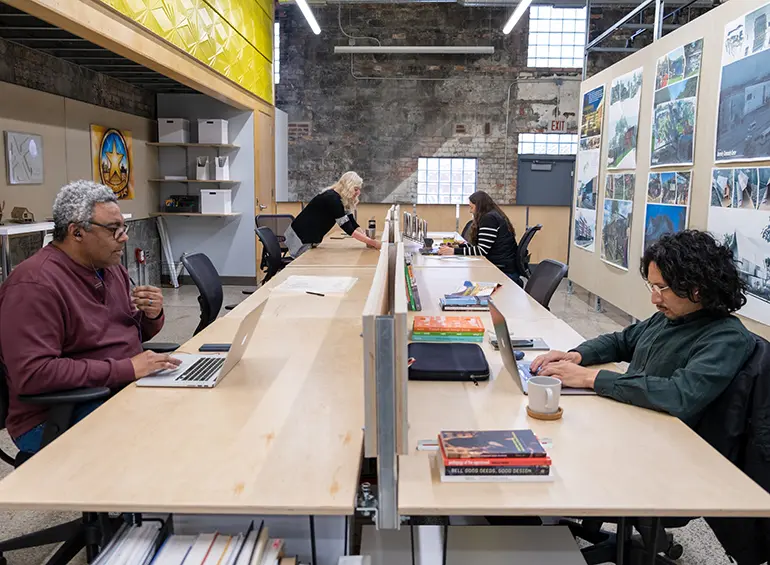
Modeled after a teaching hospital, the DCDC is a fully operational multi-disciplinary, nonprofit design center located in Detroit Mercy’s School of Architecture & Community Development. For approximately 30 years, DCDC has existed to bring high-quality and community-engaged design to all neighborhoods in Detroit. DCDC accomplishes this by engaging, educating and promoting equity in design processes.
-
Visual Arts and the Built Environment
Visual Arts and the Built Environment (VABE) is a unique program offered by the University of Windsor’s School of Creative Arts in collaboration with Detroit Mercy’s School of Architecture & Community Development. It is a cross-border, dual-degree program that combines the study of art and architecture.
For the first three years, each VABE student can take courses simultaneously in Windsor and Detroit, and receive a Bachelor of Fine Arts granted by the University of Windsor. If qualified students wish to continue their studies in architecture, they may attend Detroit Mercy to earn their Bachelor of Science in Architecture and Master of Architecture in their fourth and fifth years, respectively.
Ultimately, each VABE student graduates at the end of their fifth year with a Bachelor of Fine Arts from University of Windsor and a Bachelor of Science in Architecture and Master of Architecture from Detroit Mercy.
-
Nurturing Global Citizens
SACD aspires to nurture engaged global citizens, who can think broadly and act locally. We offer unique full semester programs in Volterra, Italy (established in 1984), and Warsaw, Poland (established in 1980). SACD also provides a 10-day program in Cuba (established in 2012).
-
Leading a Critical Practice
The professions of architecture and community development encompass both education and practice. One does not feed the other. Instead, they learn from each other — education inside and outside of the classroom, where education includes learning by doing. SACD is home to the second oldest co-op program in the country. This enterprise takes a critical approach on educating practice-ready graduates. SACD educates architects and community developers who are ready to critically adapt to and lead in a changing practice.
SACD is a mission-driven school that envisions a world with just, ecological and inspiring communities and built environments, which in turn create just, ecological and inspiring cities. We strive to educate and nurture a diverse and distinctive array of architects and community developers. With this in mind, we work to be an international resource on equitable development and architecture for all people.
SACD Vision: Our view of the world beyond ourselves
SACD envisions a world with just, ecological and inspiring communities and built environment, which in turn create just, ecological and inspiring cities.
SACD Mission: Our slice of the work necessary to reach the vision
SACD educates and nurtures a diverse and distinctive array of architects and community developers who strive to create just, ecological and inspiring communities and cities. SACD is an international resource on equitable development and architecture for all people.
-
J.E.D.I. Affirmation
Mosaics + Communities within SACD
SACD has a vision that celebrates variety over singularity. Like a mosaic—where each ceramic tile is a different color, shape and identity, and helps compose a bigger picture, we thrive when each of us retains our identity while still being a part of a larger community. Each person at SACD is a unique and cherished individual and community member. Our differences bring richness and depth.
Mosaics + Communities within our Disciplines
We have a mosaic of communities that make up our cities and towns. This requires a mosaic of architects and community developers to create equitable, ecological and inspiring work with them.
Unfortunately, this does not exist. Today, only 2% of all licensed architects are African American, and only 0.3% are African American females. In our colleges and universities, people of color make up less than 20% of the faculty who teach architecture students. Only 5% of architecture faculty across the U.S. are African American.
SACD believes that people with the same backgrounds, heritage and/or cultural understanding working on an issue, will develop results that rarely do more than validate old methods. In other words, like minds seldom develop new ways of thinking. As a discipline, our future must lead in a way that will change these statistics. The core of what guides and drive us must be rooted in justice, diversity, equity and inclusion.
-
Community Development Department Background
The Community Development Department (CDD) originally began as a degree program offering a Master of Community Development (MCD) within SACD, which was then named the School of Architecture. On Oct. 30, 2020, the University Board of Trustees approved changing the name of the school to the School of Architecture & Community Development. Following this move, the Community Development Department (CDD) was created. Both the new name and department were official in August 2021. The MCD is a 36-credit-hour graduate program. Its first graduate was in 2006. The degree program is designed as part-time and geared toward non-traditional students and working adults. The core curriculum is taught in evening, weekend and/or intensive format. The program prepares graduates for a variety of leadership roles in community development, including municipal government, non-profit organizations, social service agencies and real estate development.
The CDD and the MCD program are mission driven and focus on preparing students to participate in developing just and sustainable communities where everyone has the opportunity to engage and meaningfully influence the decisions that impact their lives. MCD’s holistic approach to the theory and practice of community development is rooted in service, social justice and sustainability — the three-part philosophical and ethical foundation of the program. These values are embodied in each of the program’s core courses. Its theoretical approach to teaching community development stresses examination of structural injustices impacting urban areas and marginalized communities. Its practical approach to community development stresses respect for and inclusion of the richness of human diversity that constitutes just and sustainable communities. Working in teams, students learn the skills of listening to and valuing the perspectives of those whose life experiences may be quite different. The program centers on marginalized communities, whether urban, suburban or rural, though there is a special emphasis on the urban context, given the program’s location in Detroit and community connections.
Additionally, the department and degree program integrate human, organizational, physical and economic (HOPE Model) aspects of community development for a comprehensive and integrated approach to the renewal of communities. To support this holistic approach, the MCD program includes faculty from a number of different academic departments as well as practitioners in community development to provide a broad interdisciplinary foundation resulting in a program that combines theory with practical application.
Ultimately, SACD is a mission-driven school that envisions a world with just, ecological and inspiring communities and built environments, which in turn create just, ecological and inspiring cities. We strive to educate and nurture a diverse and distinctive array of architects and community developers who aspire to create just, ecological and inspiring communities and cities. With this in mind, we work to be an international resource on equitable development and architecture for all people.
“SACD is more than just a building or a college – it is an innovative institution that transforms students into accomplished architects, designers and community developers in a setting that promotes creativity, compassion and inclusion.”